Saturday, 31 October 2015

Up the Nar Phu Valley - trekking 1

Namaste
The Nar Phu Valley is a remote area north of the Annapurna mountains and is accessed by a path along a narrow valley from the famous and popular Annapurna Circuit Trek.  We passed through a decorated gateway at the entrance to the valley.  We were to see lots of these during our travels in Manang.
The path went up the steep valley which carries the combined Nar and Phu rivers out of the high valley. We followed a well trodden path that started in broadleaf forest but as we climbed the vegetation turned to conifer and then became sparser and the landscape more barren.
There was so much of interest to see.
The steepness of the valley sides and their height. On both sides were mountain ridges.  The path in places had been carved into the rocky cliff. At all times we could hear the river below us.
Path carved into the rocky cliff


In one place the river had been bridged by a massive chunk of ice from a glacier which must have fallen from very high up the mountain, perhaps dislodged by the earthquake. However, despite the monsoon heat it had not completely melted away.  The river was flowing under it, and the ice was obvious.


Further up we came to a large waterfall - with the path (and us) actually going through behind the falling water.


The people who live in this remote valley have no road access and there is a 2 day minimum walk to get there. Mules are used to carry heavy supplies and we saw numerous mule-trains loaded with sacks of cement, rice and other heavy essentials on the path.


Eventually after many hours of walking we climbed up a steep slope and found ourselves on a small plateau with a few houses.  This was Meta and our lodgings for the night. In the distance across the deep gorge, eroded by the river, we could see a colourful Buddhist monastery - this would be our accommodation in a few nights time on our return. The photo shows how desolate the landscape is in that area.


Tilicho Tal - highest lake in the world

Namaste.
Tilicho Tal - the highest lake in the world.
Our long trek took in a detour to Tilicho Tal, at 4920 metres the highest lake in the world.


We started walking before it was light, to be there early - apparently the wind is vicious later!
Watching the sun come up behind the mountains was magical.

Path across the landslides.


The walk up was strenuous and slightly scary, having to cross landslides with lots of loose scree, and a huge drop below if you missed your footing.


Strange shaped eroded rocks


We saw amazing eroded rocks and the deep, deep river valley. (Actually the same river that passes by Besisahar - but so different!)

The river far below
Autumn colours by the path, mountains behind
Hard walking but what stunning views!


Tilicho Peak, just over 7000 metres in height


At the top the prayer flags were torn to tatters by the wind.


The stunted grass was decorated with hoar frost.


How different this landscape is; the colours, the vegetation, the terrain. I've never seen anywhere else like it.  All around were beautiful snow-capped mountains.  I hope you find the photos interesting.
Lake Titicho - Ice from the snout of the glacier falling into the lake.


Wednesday, 7 October 2015

Post quake Bungamati

Namaste.
Some of this blogs longtime followers may remember a post published here two years ago in October 2013,  entitled "Village life in the Kathmandu Valley".  In that post I describe what I saw on a visit to the village of Bungamati; the traditional old houses lining narrow alleys, the village square with its old temple, the rice drying in the square, wood carving and people going about their daily life. It was a picturesque unspoilt traditional village.

How shocking was the change to this village, when I visited again this week, and witnessed the destruction caused by the earthquakes earlier this year.  Many houses had fallen or were so badly damaged that they have had to be pulled down. Walk along any lane and there are big gaps where once houses stood. Sometimes the destruction of one house leaves its neighbour with rooms open to the world.

Wooden props were in place against walls, to try to keep houses standing until they could be repaired. Cracks in some walls indicated that the building was almost beyond salvage and would need to be pulled down.


Piles; rubble, bricks, wood, dust and remnants of the household indicated the position of some homes. Pieces of carved wood reminded one of the traditional trade of these Newari villagers. The broken terracotta pot discarded with the other remains of someones home was a poignant reminder of what these people had lost.

In every lane we saw stacks of bricks and wood, salvaged from the demolition of the old buildings. The bricks were neatly stacked and waiting to be used in the rebuilding, nothing is wasted.


This years vegetation surrounding a
colourful lion statue


The old temple, which had dominated the centre of the village square is sadly no more!  As we wandered around where the square had once been we saw pieces of statues from the temple amongst the rubble.
Broken lion statue amongst the rubble.


The old temple two years ago.
All that remains of the temple in the village square.


View over the village square today - without the temple.

How heartbreaking for the residents of this once attractive village.


However, to demonstrate the resilience of the Nepali people, my final photo of this post shows a woman in the village, sitting on her doorstep, stringing purple flower heads that she had collected, to make the special garlands given to brothers at the forthcoming festival.  Life goes on!


Monday, 5 October 2015

School farewells

Namaste.
As my 2 year placement here in rural Nepal comes to an end, my last few weeks have been spent visiting the twelve schools I have worked with over the last 22 months, to collect data about improvements in teaching and learning and feedback about the project from the Headteachers of each school. (see blog page 'Success?')

As these visits have been my last to each school, many arranged farewell ceremonies for me, in the traditional Nepali way.  Red tikka powder is smeared on my forehead, a silk scarf (kata) and a garland of flowers (malla) placed around my neck. The kata scarves have beautiful Buddhist symbols on them, for good luck.  It is a lovely way to say goodbye! (However I have found that the tikka has stained my hair - so I now have a red tinted fringe!!)

Little Sisters singing their song .......
At one school a pair of the Little Sisters that I worked with had written a song which they sang for me, and another had written a poem of thanks. At another school a group of Big Sisters sang to me. How blessed and honoured I feel to be treated like this, and sad to say goodbye to such lovely people.


..... and the Big Sisters at another school

Below are some of the photos taken of me during or after these ceremonies.  Sadly from some schools I have no photos.

Overwhelmed by so many garlands.
A Big Sister and Youth Volunteer who had come
to say goodbye
The English teacher reading a letter of appreciation.


Flowers and tikka from every child.


Thank you to all the teachers and headteachers that I have worked with for your friendship and acceptance.  I know many of you have worked hard to make your schools more girl-friendly, so that the Little Sisters actually want to be at school and do well in their education. Keep up the good work!
A fitting quote for the project, found on the wall of one school.

Saturday, 3 October 2015

Success?

Namaste.
What is success? Has the work that I have done here in Nepal been successful?  Have I made a difference?

After 22 months working in Lamjung it is time for me to look at what has been achieved with the 12 schools and teachers involved in the 'Sisters for Sisters Education in Nepal Project'. This project aims to encourage more young girls to attend and stay at school to complete their education. These girls are the 'Little Sisters'. They are supported by 'Big Sisters' older girls from the community who have completed their education.
Fortunately my last job in Lamjung was to collect data about the lessons and the schools, using the same criteria as had been used at the start of the project, so providing up to date and measurable data.

Almost 2 years ago many of the lessons I observed comprised of teachers talking and students listening.  In some the teacher talked through the whole lesson and the students did nothing except listen! Lessons were mostly unplanned, taught from the textbook and there were no resources used to help with understanding or learning. Behaviour in some lessons was poor and there did not seem to be good respect between teacher and students. In many lessons students appeared to be bored.

The girls side of the class
A serious feature of many lessons was the domination by and favouritism for the boy students. This was easy to see because boys and girls sat on different sides of the classroom.  I saw teachers facing the boys side of the room for the whole lesson, only asking the boys questions, choosing boys to read and, in one case, only marking boy's homework.  Boys were allowed to shout out the answers to questions, even when a girl was asked the question. The girls sat meekly in the classrooms and in most cases accepted this unequal treatment. Having watched one lesson where the teacher completely ignored the girls in the class, I asked him if he had forgotten them. He replied that "They wouldn't have wanted to answer questions anyway, so there was no point in asking them."!
Two Little Sisters at one hilltop school

The schools had a similar disregard for girls rights and needs. In many schools the girls toilets had no running water, nowhere private for girls to wash and change sanitary towels and no bin for used ones to be disposed of. In one school the girls toilet door (one toilet only) did not even shut properly or lock. It was not surprising that many girls would not attend school when they were menstruating.
Also boys dominated the everyday life of many of the schools. Boys led daily assembly, represented students on student councils and management committees and were chosen for many important leadership roles. At break times the play areas were normally used for the boys football games, leaving the girls nowhere to play active games. That was two years ago!

And now.....
Mixed seating for lesson in temporary classroom.
I cannot say that all these issues have been completely resolved, but in all schools there has been change.  Some schools now have mixed gender seating arrangements; girls and boys sitting on the same benches, meaning that teachers can't just face the boys.  Many other schools plan to introduce this during the year. In almost all of the 36 lessons I observed there was equal teaching of boys and girls, although there was still some boys domination in a few lessons which went unchecked by the teacher.  I observed almost no favouritism towards the boys by the teachers.

Prepared resources used in lessons

It is good to report that, in most of the schools, lessons have improved.  In no lesson did I see the teacher talking for the whole lesson and all had some student activity.  In many lessons the teacher had obviously planned the lesson and brought prepared materials e.g. word cards, to contribute to learning activities. Behaviour was good in many lessons, much improved from two years ago, perhaps because there is now more respect between teacher and students.


Most schools have included gender sensitive issues into this years School Improvement Plan and Headteachers report that the project has had a big impact on their schools.  Some girls toilets have already been improved whilst plans for improving most others have been formulated and included in this years School Improvement Plan.
Girls playing football. 

I've observed girls playing volleyball and football during break times, in the area once only used by the boys. In several schools girls were leading daily assembly and in others they had special responsibilities for other activities.

Girls leading assembly


Female teachers too are becoming more assertive and acting as role models for the girl students.
Happy to be at school!
Finally many girls seemed much more confident, and appeared happy to be at school.


Almost all of the 320 Little Sisters that we have been working with from the start of the project are still attending school regularly, which is a success story in itself!


There are other beneficiaries however, unplanned for in the original project proposal. The Community Mobilisers, who work supporting the Big Sisters and involving the local communities, have grown in confidence and developed new skills. They speak confidently at large meetings of teachers and/or community members about the project or the rights of girls and women. The Big Sisters too have increased their confidence and skills, and I hope many will go on to find work in the future where these attributes can be used.  Well done to you all!

I feel sure that this project has made a difference to the future prospects and life chances of at least some of the girls, Little Sisters, that we have been working with.  If this is so then the project has been worthwhile.

Wednesday, 30 September 2015

Teej at Milanchowk

Namaste.
Suchana, who works at GAN Lamjung as the Finance Officer, invited Judith and I to stay with her family at their village home in Milanchowk for the Teej celebration this September.  After 5 hours in a very hot and crowded bus, it was a relief to arrive at Milanchowk, just as the day began to cool down.  Suchana had warned us that her family were very excited that we were coming, and we were honoured with a traditional welcome when we arrived.
The Khaniya family comprises of Dad - Govinda, Mum - Sobha, and their four children; Suchana, Sushil, Anjana and Santosh. 

Their home is a traditional Nepali house with two storeys, built alongside a much older round house where their Grandmother now lives.
The old round house 
Early the next morning we went to join the family cutting grass for the livestock. (See 'Cutting grass' blog page)Whilst we did this Sobha milked the buffalo.

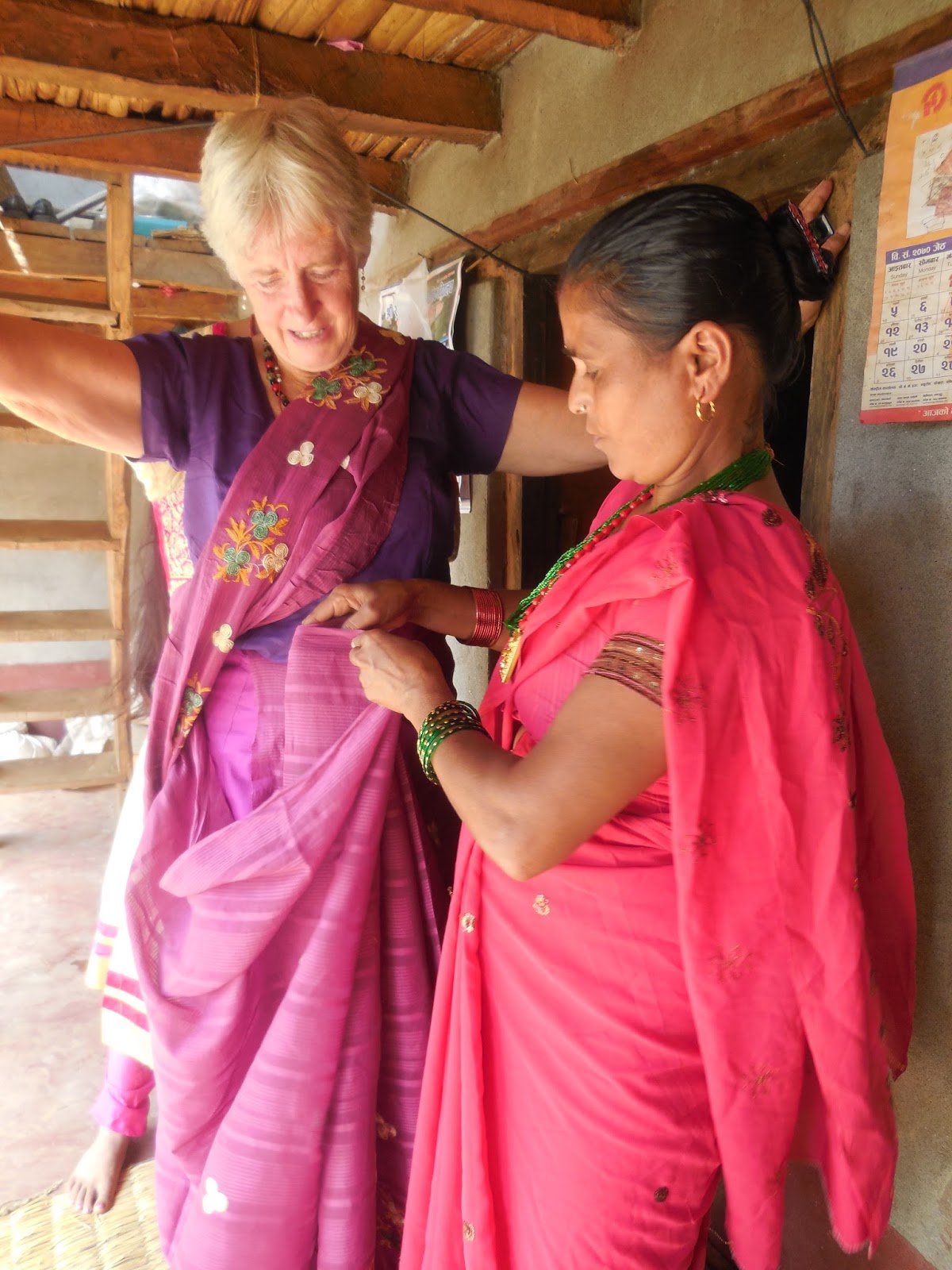
Soon it was time to get ready and put on our saris.  We had bought saris specially for the occasion, but both Judith and I were anxious about wearing one, as the material is just wound around you and tucked in. Not very secure we thought!!  Sobha did this for us - winding the material around the waist and then folding it into soft pleats which hang at the front. All the material is tucked into the top of the cotton petticoat which is worn underneath.  Finally the decorative end of the sari is placed over the shoulder and allowed to hang.
Necklaces, bracelets and our purple bourganvilla garlands from the previous evening were hung around our necks, with tikkas on our foreheads as a final decoration.  Of course, photographs had to be taken and then we were ready to walk to the village square where a singing and dancing competition was taking place in honour of Teej.
All along the track to the village came women of all ages, decked out in splendid red and green saris, on their way to watch the dancing. Everyone we met remarked that we were like 'Nepali women' in our saris and decoration. 

An area for dancing had been roped off, and a tent erected for local 'thulo manche' (literally big men, used to describe important people). We sat on the steps in the shade of the mandir waiting for the performances to begin. We had obviously arrived early so that we got good seats, because over the next two hours our "good seats' became very squashed places as many more tried to squeeze in. 
I got restless and wandered off to see and take photos of the beautifully dressed women and girls in the crowd. Their ages were spread across the spectrum as can be seen from the photos below. 

The singing and dancing was a competition, and was interesting to watch. In each entry a group of women sang whilst one danced. Nepali dancing is very expressive, and hand movements are very important. There is lots of symbolism in the movements.

Taking place at the same time, obviously for the men to watch as Judith and I were almost the only women spectators, was a competition for strong young men to throw a boulder as far as they could. This sport seemed to be a combination of javelin, taking a run up to the point of throwing, and shot put, throwing from the shoulder as far as possible.
Suddenly, over the loudspeaker, Judith and I were summoned by name to the 'thulo manche' tent.  The organisers had become aware that there were two 'biddeshi' women in the audience, and having asked our hosts for our names, were determined we should be there on the platform! More tikka and kata scarves, along with a sign pinned to our saris, saying that we were special guests. It was pleasant to sit in the shade and watch the dancing, so we didn't mind too much, and 'escaped' as soon as the dancing competition finished.

Whilst the decision of the judges was being debated, women spectators were encouraged to dance. One of the officials from the platform sought me out and I had no option but to dance. I'm sure this made the day of many spectators, watching me make a complete fool of myself! As I looked around the watching crowd there were hundreds of beaming smiles and laughing faces. If there's one thing I've learnt while living in Nepal it's not to take myself too seriously, and to allow people to stare and laugh - and to smile and laugh in return.  (No pictures of me - I'm the one with the camera!)
As we walked back to the house, at the end of the afternoon, our saris still intact, the sun was dropping behind the layers of hills to the west.  We had to pose for photos with that backdrop, it was stunning! 

This few days had been another special experience to remember for many years. Thank you to the Khaniya family for your kindness and hospitality.